federal-homelab
RHEL01 STIG remediation
How RHEL01 went from 44.9% to 95.4% against the DISA STIG for RHEL 9, what was deliberately not applied, and where the applied configuration departs from the generated fixes.
| Baseline | 2026-09-16 — 44.9%, 258 failed rules |
| Post-remediation | 2026-09-20 — 95.4%, 17 failed rules |
| Benchmark | DISA STIG for RHEL 9, SSG 0.1.82, profile stig, unchanged between scans |
Method
- Rescanned the unmodified host and confirmed it reproduced the baseline score, so the rescan method was proven before anything changed.
- Pinned
openscap*andscap-security-guideindnf.conf. Patching a host normally upgrades the benchmark content, which would make the before/after comparison meaningless. - Generated the fix script from the scan results rather than from the profile, so it covers only the rules that actually failed (258 of them).
- Reviewed every fix, then split them into five stages by blast radius. 233 rules were applied by script, unmodified; the rest were handled manually or left open.
- Applied one stage at a time, each preceded by a VM snapshot and followed by a reboot and a login test from a second session before the first was closed.
| Stage | Rules | Contents |
|---|---|---|
| 1 | 69 | Packages, login banner, Ctrl-Alt-Del, sysctl hardening, kernel module blacklists, /boot and /dev/shm mount options, chrony, postfix |
| 2 | 92 | AIDE, audit rules (immutable), auditd disk-space actions, audit kernel arguments |
| 3 | 41 | authselect, faillock, pwquality, sudo re-authentication, password aging, umask, session limits |
| 4 | 21 | Crypto policy FIPS:STIG, 19 sshd settings |
| 5 | 10 | GRUB kernel arguments, fapolicyd default deny, usbguard |
| Manual | 5 | FIPS mode, GRUB superuser and password, user.max_user_namespaces, usbguard audit backend, postfix relay restriction |
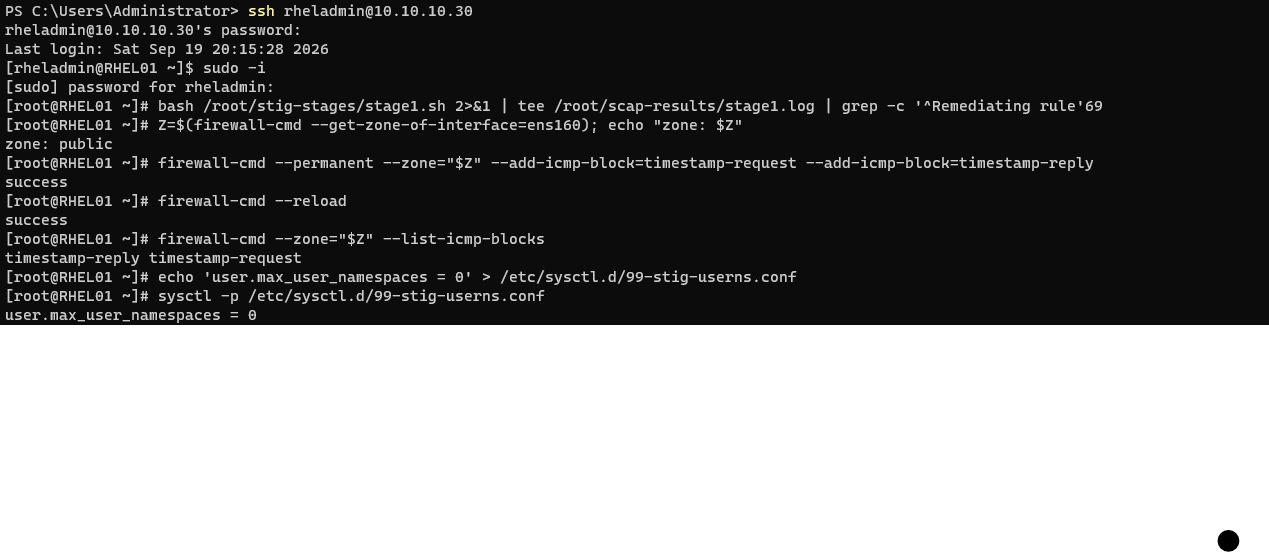
Stage 1 applied, followed by two of the manual deviations described below — the firewalld ICMP block and the user-namespace restriction:
Deviations from the generated fixes
Four changes depart from what the content produced. Each is a deliberate, documented decision.
| Change | Reason |
|---|---|
maxdistance 16 in chrony.conf |
The lab’s only time authority is the domain controller, and Windows Time advertises a ±10 s error bound. Chrony’s 3 s default rejected it, so the host had never synchronised at all — before or after hardening. Not a STIG rule, but accurate time underpins the audit records the STIG requires |
PrivateUsers=false drop-in for irqbalance |
The STIG’s user.max_user_namespaces=0 prevents any service using a user namespace from starting. irqbalance was the only enabled service affected; it keeps its other 14 sandbox settings |
| ICMP timestamp request/reply blocked in firewalld | Closes a Nessus finding (plugin 10114) that no STIG rule covers |
mac@SSH order in STIG.pmod |
See below |
A conflict inside the benchmark
Three rules in SSG 0.1.82 disagree about SSH MAC ordering, and they cannot all pass at once:
| Rule | Expects |
|---|---|
fips_custom_stig_sub_policy |
mac@SSH=HMAC-SHA2-512 HMAC-SHA2-256 in STIG.pmod |
harden_sshd_macs_openssh_conf_crypto_policy |
hmac-sha2-256-etm@openssh.com,hmac-sha2-512-etm@openssh.com,hmac-sha2-256,hmac-sha2-512 |
harden_sshd_macs_opensshserver_conf_crypto_policy |
The same string, via -oMACS= |
The sub-policy generates the back-end files, so its ordering determines what the other two rules
see. Both orderings permit the identical four algorithms and differ only in negotiation
preference, so this is a scoring question rather than a security one. The 256-first ordering was
chosen because it satisfies two rules instead of one. fips_custom_stig_sub_policy is carried as
an open item with this explanation rather than being silently dropped.
The equivalent ciphers rule is unaffected: its two orderings happen to agree.
Operational effects
Hardening changed how the host is administered. Recorded here so the behaviour isn’t mistaken for a fault later:
| Effect | Detail |
|---|---|
| Account lockout | 3 failed attempts locks the account with no automatic unlock, root included. Recovery: faillock --user <name> --reset as root |
| sudo | Re-authenticates every invocation (timestamp_timeout=0). Multi-line pastes that contain sudo will feed following lines to the password prompt; use a root shell instead |
| SSH | Root login refused, sessions dropped after 10 minutes idle, ed25519 host key no longer offered under FIPS:STIG — clients see a host-key change once |
| Passwords | 15 characters, 4 character classes, 60-day maximum age, 1-day minimum |
| Boot | GRUB requires the superuser credentials to edit an entry or reach the command line; normal boot is unattended |
| Audit | Rules are immutable until reboot, and auditd halts the system if the audit filesystem fills |
Not remediated
17 rules remain open, each for a stated reason: platform substitution (1), filesystem layout (6), missing lab infrastructure (7), risk-based deferral (2), and the benchmark conflict above (1). They are listed in the post-remediation scan summary and carry into the POA&M.