PowerShell Encoded Command
| Field |
Value |
| ATT&CK technique |
T1059.001 — Command and Scripting Interpreter: PowerShell |
| Tactic |
Execution |
| Log source |
Windows Security event log (WS01), PowerShell Operational |
| Index |
lab_win |
| Severity |
High |
| Status |
Validated — 2026-09-24 |
| Author |
Samuel Emerson |
| Created |
2026-09-24 |
| Validated |
2026-09-24 — evidence |
Hypothesis
powershell.exe -EncodedCommand <base64> runs a Base64-encoded script without it ever appearing
in plain text on the command line. It is a staple of loaders and living-off-the-land activity,
because it defeats casual command-line inspection and simple keyword filters. Legitimate software
occasionally uses encoded commands, but on a workstation an interactive user launching one is
unusual and worth review.
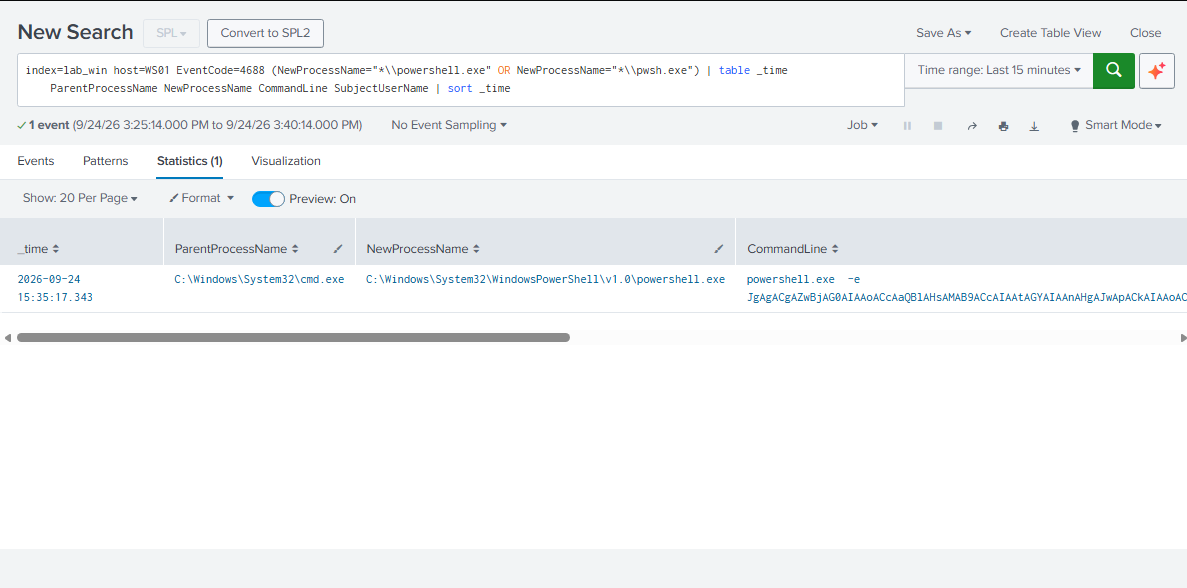
Windows records the launch as Security event 4688 (with command-line auditing enabled), so the
encoded flag and its argument are visible there. PowerShell script-block logging (event 4104)
records the decoded script separately, which is what confirms what actually ran.
Detection logic
index=lab_win source="XmlWinEventLog:Security" EventCode=4688
    (NewProcessName="*\\powershell.exe" OR NewProcessName="*\\pwsh.exe")
| regex CommandLine="(?i)\s[-/](e|ec|en(c(o(d(e(d(c(o(m(m(a(n(d)?)?)?)?)?)?)?)?)?)?)?)?)\s+[A-Za-z0-9+/=]{16,}"
| table _time host SubjectUserName ParentProcessName NewProcessName CommandLine
PowerShell accepts any unambiguous abbreviation of -EncodedCommand (-e, -en, -enc, …), so
the pattern matches the flag at any length, followed by a Base64 string of at least 16 characters.
It also accepts the / switch form. Confirming what ran uses 4104:
index=lab_win source="XmlWinEventLog:Microsoft-Windows-PowerShell/Operational" EventCode=4104
| table _time host ScriptBlockText
Field reference
| Field |
Source |
Meaning |
EventCode=4688 |
Security log |
A new process was created |
NewProcessName |
4688 |
The executable path — powershell.exe or pwsh.exe |
CommandLine |
4688 |
Full command line, including the encoded flag and payload |
ParentProcessName |
4688 |
What launched PowerShell |
EventCode=4104 |
PowerShell Operational |
Script-block text — the decoded command |
Validation
| Item |
Detail |
| Atomics |
Atomic Red Team master, downloaded 2026-09-24 |
| Test |
#17 PowerShell Command Execution · a538de64-1c74-46ed-aa60-b995ed302598 |
| Executed at |
2026-09-24 15:35:15 CDT (execution log) |
| Command observed |
powershell.exe -e <base64>, parent cmd.exe. Decoded, the payload was a benign Write-Host 'Hello, from PowerShell!' — the encoded form is what the detection keys on, not the content |
| Detection fired |
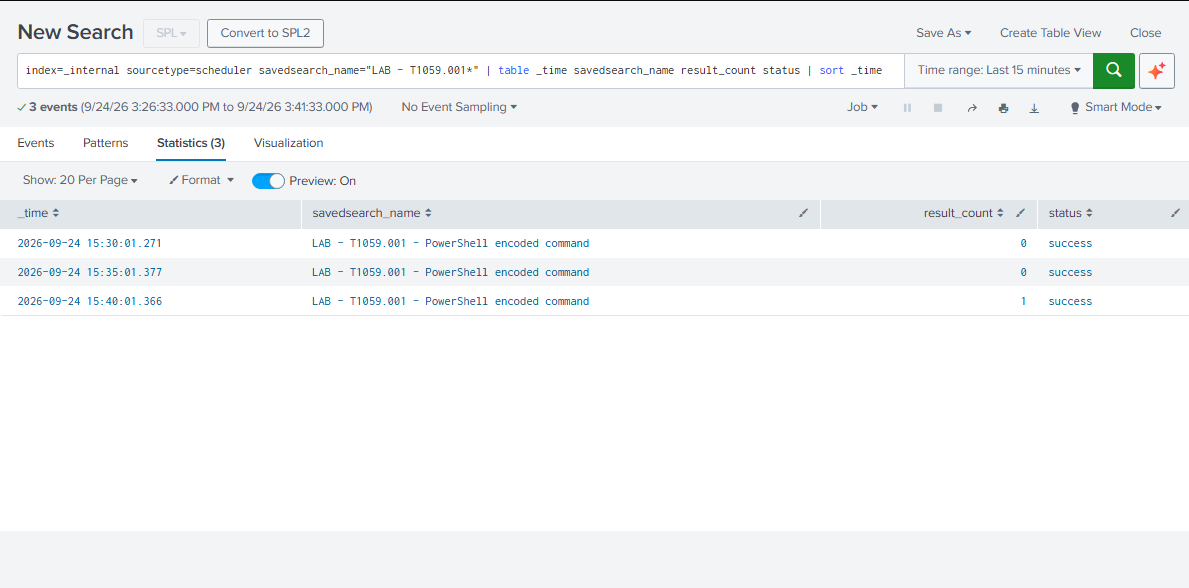
Yes — scheduled run at 15:40:01, 1 result (alert log) |
| Time to detect |
4 min 44 s |
| Evidence |
4688 event · screenshot · alert screenshot |
| Cleanup |
None required; the test starts no persistent process |
False positives
| Scenario |
Likelihood |
Tuning |
| Management tooling running encoded commands |
Medium in production |
Allowlist the parent process or the service account |
| Software installers using encoded bootstrap commands |
Low–medium |
Allowlist by parent image after a baseline |
| Administrator pasting an encoded one-liner |
Low |
Correlate with the 4104 decoded content before escalating |
Response guidance
- Pull the matching 4104 event and read the decoded script.
- Check the parent process — an Office app or a browser launching encoded PowerShell is far more
serious than a console session.
- Look for network connections (Sysmon event 3) from the PowerShell process.
- If unexplained: isolate the host, preserve the script-block content, and pivot to the parent
process tree.
Gaps
- Encoding is only one launch style. Download cradles (
IEX (New-Object Net.WebClient)...),
-Command with obfuscation, and fileless execution are separate cases; script-block logging
(4104) is the backstop that captures them regardless of launch flags.
- PowerShell version 2, if present, does not write 4104. Not applicable on WS01.
NIST 800-53 mapping
| Control |
Relevance |
| AU-2 / AU-12 |
Audit of process creation and script-block content |
| SI-4 |
System monitoring for malicious execution |
| SI-3 |
Malicious code — encoded execution is a common delivery method |